How accurate should a cross-line laser be?
The accuracy of a cross-line laser decides whether walls stand straight, kitchens are installed exactly and tile grids line up perfectly. But which tolerance is "good enough" – and which devices deliver that precision reliably?

In this article

Recommendation
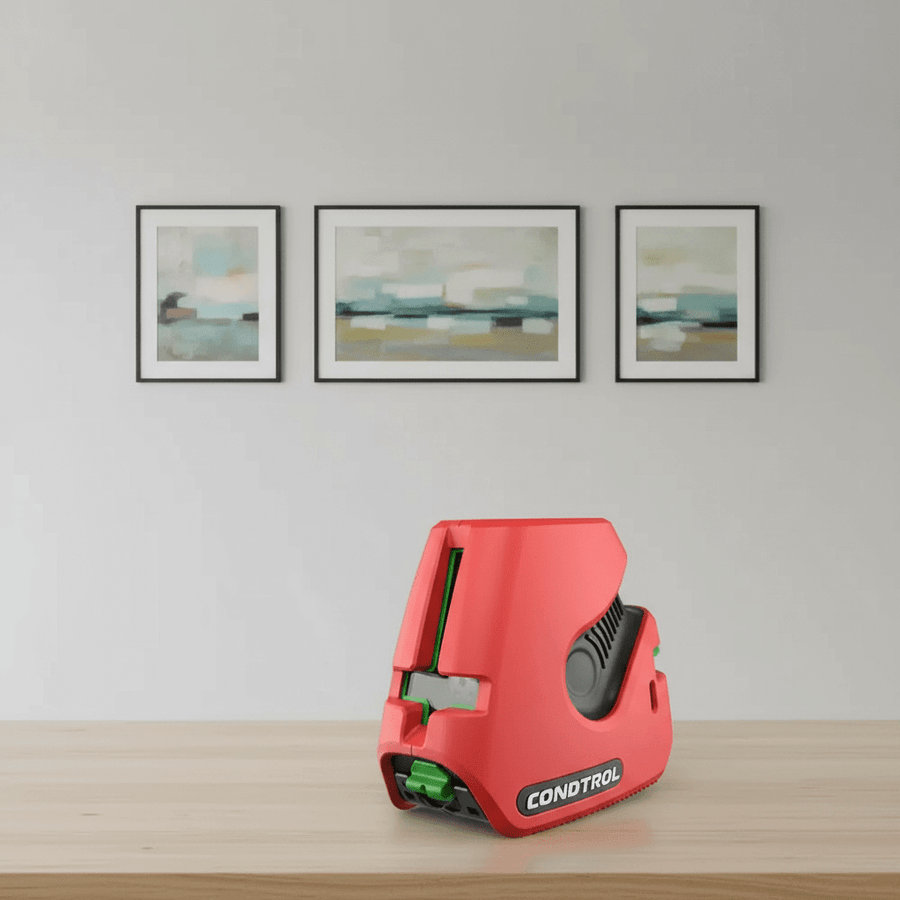
CONDTROL Smart 4D Plus cross-line laser
Self-levelling with two horizontal and two vertical green 360° planes; in pulse mode it can also be used with a detector for longer ranges.
€239.90View product
What does the specification "accuracy ±0.2 mm/m" mean?
This figure describes how far the projected line may deviate per metre from the ideal horizontal/vertical. At 0.2 mm/m that would be, for example:
- ±0.2 mm over 1 m
- ±2 mm over 10 m
- ±4 mm across a whole room of 20 m
It sounds small – but it is decisive when cabinets have to hang flush or tile grids have to run through. An example of professional precision: the CONDTROL Smart 4D Plus with ±0.3 mm/m – sufficient for almost all interior fit-out work.
How much accuracy do you really need?
0.3 mm/m – solid semi-professional class
Sufficient for typical DIY projects, shelves, lamps and simple installation work. Precise enough, but less stable over long distances. Examples: Smart 4D Plus, Boden 3D
0.2 mm/m – professional standard
The range in which real professional lasers work. Ideal for drywall, kitchen fitting, bathrooms & tiling, interior fit-out and trades where repeatability is decisive. Recommendations: Omniliner G3D, XLiner Pento 360G
0.1 mm/m and better – high-precision devices
Rare in cross-line lasers, more common in rotary lasers or special tools. Required for large rooms, long axes and outdoor applications. Example: Roto HVG 600 with ±0.05 mm/m
Why does a laser not always reach its official tolerance?
Manufacturers state laboratory values. In practice, many factors influence the line:
- Transport & vibration: a knock can shift the pendulum block.
- Temperature: expansion of components changes the reference position.
- Cheap designs: plastic frames deform, metal frames do not.
- Changes in height: a laser on an unstable tripod → drift in the line.
That is why reputable manufacturers calibrate every device before shipping – at CONDTROL this is part of the normal quality process.
Why the design matters more than the number on the box
Many cheap lasers advertise good tolerances but cannot hold them. The reason: the internal components.
- Metal frame instead of plastic – more stability, less drift.
- Optical modules screwed, not glued – reproducible over time.
- Solid pendulum bearing – fewer shocks, less wear.
- Serviceability – devices can be readjusted precisely.
Examples of robustly designed devices:
- Smart 4D Plus – metal housing, serviceable, 2×H + 2×V
- Omniliner G3D – all-metal inner frame
- Pento 360G – strong mechanics, 3×360°
How to check the accuracy yourself
- Point the laser at a wall and mark the horizontal line.
- Turn the device by 180° and mark a second line.
- Measure the distance between the two lines.
Rule of thumb: more than 3–4 mm deviation over 10 m means calibration makes sense.

Recommendation
CONDTROL Boden 3D cross-line laser
Levelling accuracy ±0.3 mm/m, metal frame in a rubber-protected housing and a horizontal 360° line just 18 mm above the floor.
€165.00View product
Which devices suit which precision requirement?
For professional interior fit-out
Omniliner G3D · Pento 360G · Smart 4D Plus → stable, serviceable, precise.
For DIY users who want good quality
Cross-line lasers overview → good value for money.