Is a cross-line laser worth it?
In short: a cross-line laser pays off if you repeatedly transfer heights, vertical lines or several reference lines. For hanging a single picture, a spirit level may be enough. What matters is your task, the lines you need and the permissible deviation – not the largest possible number of laser planes.

In this article

Recommendation
CONDTROL Smart 4D Plus cross-line laser
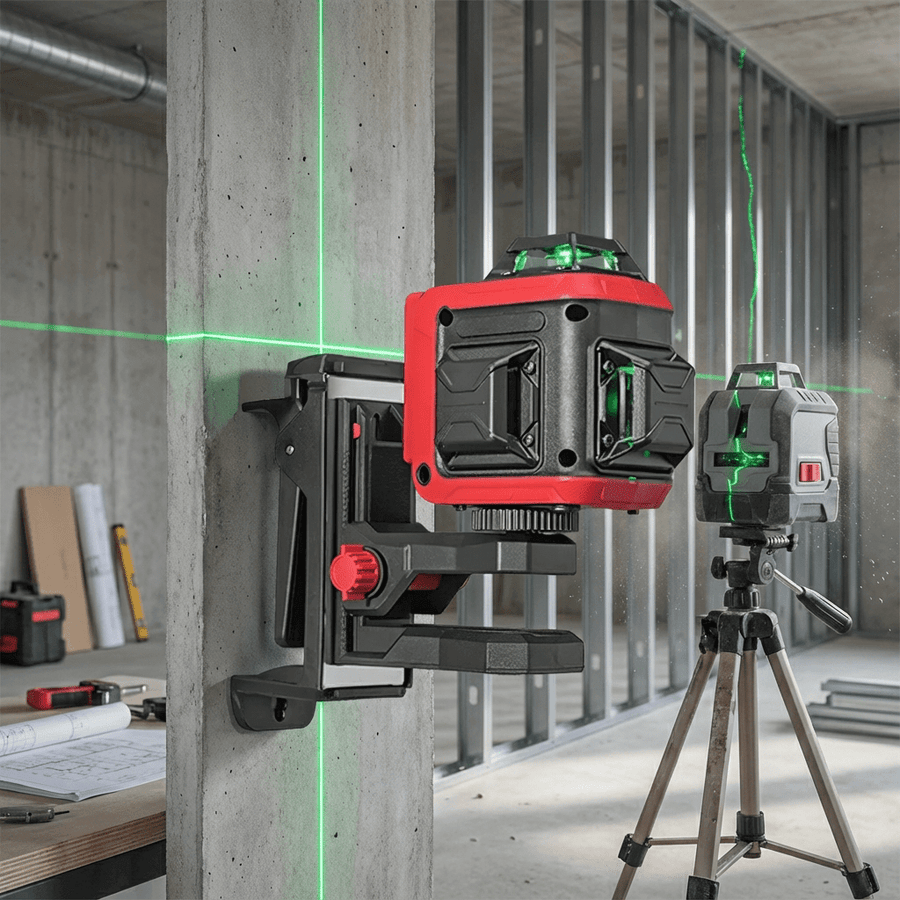
Projects two horizontal and two vertical green 360° planes, giving you reference lines on all walls and the ceiling at the same time.
Why a cross-line laser makes sense
A spirit level, string line or plumb bob can deliver accurate results. A laser, however, makes a reference line visible at many points at once and makes repeated alignment easier. With self-levelling, the device must stand within its levelling range; line shape, visibility and accuracy depend on the model and the working conditions.
- Work faster: the lines are there in seconds.
- Check the accuracy: a specification of ±0.3 mm/m corresponds mathematically to ±3 mm at 10 m. Choose the device according to the tolerance you need.
- Repeatable: heights, axes and grids stay identical.
- For many tasks, references can be transferred without a second person.
- Avoid mistakes: less waste, less rework.
Typical jobs where a laser helps
1. Drywall and profile installation
For profiles and room layout you need a horizontal reference and matching vertical references. A horizontal 360° line all around the room makes it easier to transfer identical heights. When comparing 3D cross-line lasers, check the fan angle of each plane; the label 3D alone does not guarantee three full 360° projections.
2. Tiling & plumbing (two planes at once)
Two horizontal planes help when you need a line close to the floor and a second height at the same time. To align a single tile grid, one horizontal and one vertical reference are enough. Plan joints and edge pieces before laying.
3. Kitchen & furniture installation
Align wall cabinets and reference heights to a horizontal line. For a single wall a 2D model is often enough; several 360° planes are not strictly necessary.
4. Electrical installation & grid work
Sockets, cable ducts, LED grids on the ceiling – a laser makes repeated alignment easier. Recommendation: Progressor (grid projector)
5. Work below the ceiling (mounting profiles, lamps etc.)
With a suitable wall bracket or telescopic pole, the laser can be fixed at working height. Check the thread, mounting and stability; the laser does not replace a safe working platform.
Green or red – which makes more sense?
Green lines are easier to see in many interiors. Visibility also depends on lighting, surface and distance, though. Red lines can be sufficient for short-range interior work; the models on offer differ in laser colour. In bright daylight, check whether the model supports a compatible receiver. A green beam alone does not guarantee a clearly visible line outdoors.
360° laser or classic cross lines?
A cross projection is often enough for a single wall. For heights all around the room, a horizontal 360° plane helps. Three full 360° planes are offered, for example, by the Smart 3D Plus, XLiner 3D and TruSlope; for other 3D models, check the fan angles separately. Two horizontal planes are a selection criterion for the 4D models on offer.
When is a cross-line laser especially worthwhile?
- If you work regularly in interior fit-out.
- If you want to transfer reference lines on your own.
- If you align several points to the same reference and the accuracy matches your working distance.
- If time savings & repeatability are decisive.
Why CONDTROL?
At CONDTROL, compare the projections, accuracy, power supply and scope of delivery of the specific models. A contact person in Germany is available for advice and service. The warranty is two years; an additional year requires registration in accordance with the warranty terms.