3D or 4D laser: XLiner 3D, Smart 4D Plus and TruSlope
In this article
- 3D or 4D: the decision in 30 seconds
- What do the three or four planes mean?
- Three tools, three focal points
- Example 1: wall tiles and a reference close to the floor
- Example 2: transferring profiles and ceiling height
- Example 3: aligning an inclined surface
- When is a 2D cross-line laser enough?
- Frequently asked questions
A 3D laser projects three all-round planes, a 4D laser four. The additional plane does not automatically make a tool more accurate. It helps when you need a second horizontal reference. Here you can compare the XLiner 3D, Smart 4D Plus and TruSlope according to the work you actually want to do.
3D or 4D: the decision in 30 seconds
- Several walls and right-angled axes in the room: three all-round planes are a good starting point.
- Work close to the floor plus an upper horizontal reference: a 4D tool with a suitable arrangement of the outlets makes the job easier.
- Setting and reading a defined tilt: look for a genuine angle display and the intended accessories, not just 3D or 4D.
- A single strip of wallpaper or a short section of wall: a simpler cross-line laser is often enough.
What do the three or four planes mean?
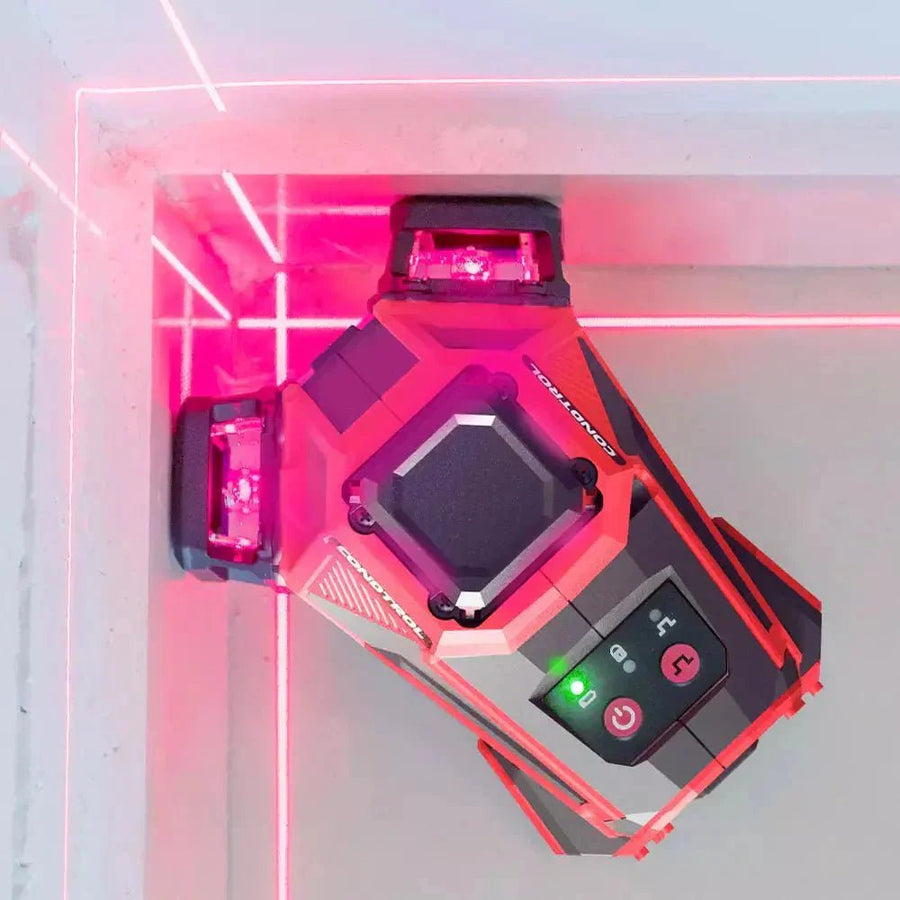
The 3D models compared here create one horizontal and two vertical 360° planes. A 4D model adds a second horizontal plane. The number describes the geometry of the projection, not the measuring tolerance or suitability for sunlight.
The two horizontal planes of a 4D tool cannot be adjusted in height independently. Their position depends on the outlets on the tool and how it is set up. So check the possible working distances close to the floor and ceiling instead of just comparing the 4D designation.
Three tools, three focal points
| Model | Planes | Focus when choosing | Check before buying |
|---|---|---|---|
| XLiner 3D | 3×360° | All-round references, display and workflow in interior finishing | Set-up in confined spaces, battery and scope of delivery |
| Smart 4D Plus | 4×360° | Second horizontal reference and work close to the floor/ceiling | Position of the outlets, bracket and required working height |
| TruSlope | 3×360° | Work where a defined tilt needs to be displayed | Angle range, accessories and procedure for the specific slope |
This is a selection comparison, not our own lab test. Current technical data, prices and scope of delivery can be found on the linked product pages.
Example 1: wall tiles and a reference close to the floor
For the top edge of a first row of tiles, a suitable horizontal line is enough. A second horizontal can help if you need another reference at the same time or are working close to the floor. But it does not plan your edge pieces and does not compensate for an uneven substrate.
If you are facing exactly this task, start with the guide to aligning the first row of tiles. It shows how to calculate wall width, joints and edge pieces before setting up. Only then does it become clear whether the additional plane saves you work.
Example 2: transferring profiles and ceiling height
A horizontal plane running all round transfers a height reference to several walls. Two vertical planes can make axes in the room visible. For a single ceiling height, a second horizontal is not required just because of the size of the room. More important are a suitable mounting height, unobstructed projection and a stable bracket.
If the bracket or tool housing blocks the line you need, additional planes help only to a limited extent. Check the set-up from the point of view of your actual working position.
Example 3: aligning an inclined surface
A locked pendulum function can make inclined lines possible. However, it does not display a defined angle. For recurring work with a defined slope, the TruSlope display is relevant. Confirm how the desired value is set and transferred to the component. A tilt angle alone does not describe a finished drainage plan.
When is a 2D cross-line laser enough?
If you need a horizontal and a vertical reference on one wall, an all-round projection is often unnecessary. This applies, for example, to the first straight strip of wallpaper. For many room axes and repeated repositioning, an all-round tool becomes more convenient.
Compare the relevant classes directly: 2D cross-line lasers, 3D cross-line lasers and 4D cross-line lasers.
Frequently asked questions
Is a 4D laser more accurate than a 3D laser?
The additional plane is no proof of accuracy. Compare the technical tolerance of the models and check the accuracy according to the manual.
Do I need four planes for a large ceiling?
Not automatically. For a common mounting height, a horizontal all-round plane can be enough. Set-up and bracket determine whether it is usable.
Can I set the two horizontal planes as I like?
The outlets have a position fixed by design. Two planes are not two independently positionable heights.
Does a green laser work outdoors without a receiver?
That depends heavily on the light and target. Check receiver mode and specific compatibility; green colour alone does not make use in sunlight reliable.
Our recommendation: First choose the reference you need on the component. Three planes for room axes, four for a useful second horizontal reference, an angle display for a defined slope. For a simple single wall, 2D can be sufficient.