Green vs red: which cross-line laser is better?
Green or red laser lines: the colour mainly determines how well you can see the reference. When choosing a cross-line laser, the plane configuration, accuracy, working environment and receiver compatibility also matter.
In this article
Green or red: the quick decision
| Situation | What helps? | What still needs checking? |
|---|---|---|
| Bright interior | Green is often perceived more clearly | Contrast with the surface and actual distance |
| Small room with normal lighting | Both colours can be sufficiently visible | Lines required and mounting |
| Working outdoors in sunshine | Suitable tool with a compatible receiver | Intended mode and range with receiver |
| Long working day | Compare the runtime of the specific model | Battery, active planes, temperature and charging options |
Green is not automatically more accurate
A clearly visible line makes it easier to mark a point. It does not make the instrument more accurate in itself. Compare the accuracy specification, the conditions in the manual and the instrument check. A wide or poorly visible line can also make reading more difficult.
Practical example: kitchen units on a bright wall
First determine the desired mounting height. Mount the tool securely and check the line at the least favourable spot, for example near a window. If the line is hard to see there, a different set-up or a target plate can help. What matters is that you read the reference reliably rather than estimating from a barely visible edge.
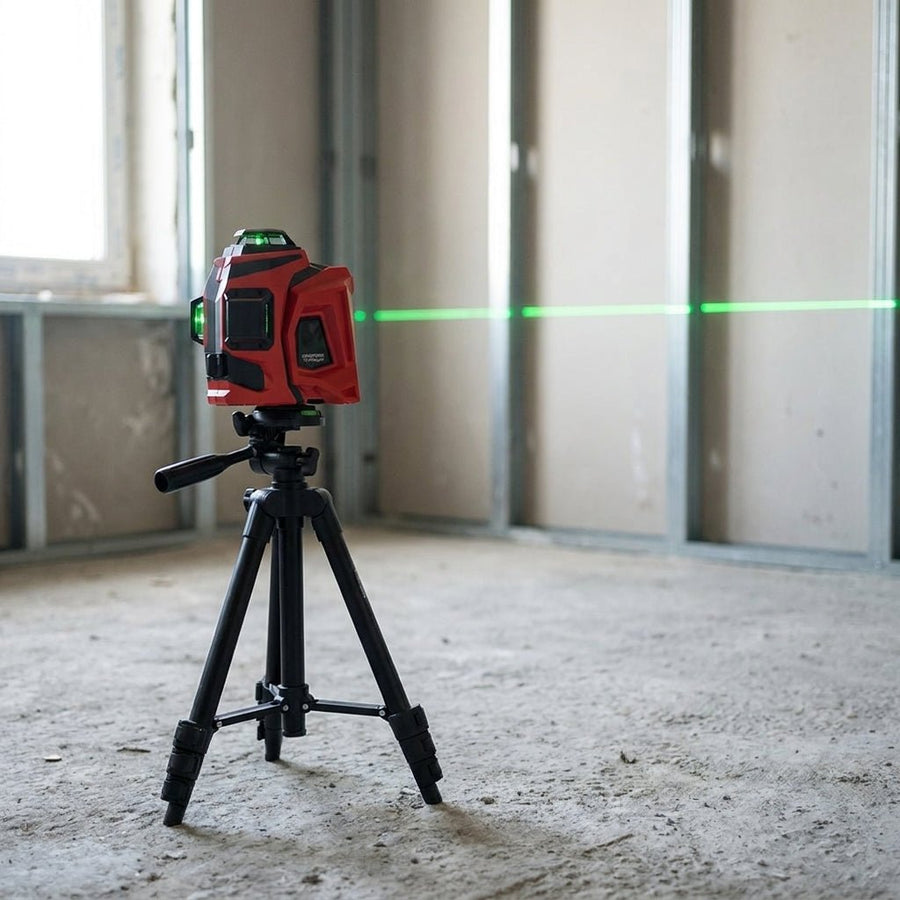
For a single wall, a line cross may be enough. The Smart 2D Plus is green and produces a line cross. For references all around the room, compare the 3D configurations or 4D configurations. A higher number of planes is no reason to choose the tool for every simple task.
Outdoors, more counts than colour
Green lines do not remain visible indefinitely in strong daylight. For working with a receiver, the laser and receiver must explicitly match. Check in the manual whether a receiver mode is provided and which receiver is supported. Not every receiver automatically works with every green or red laser.
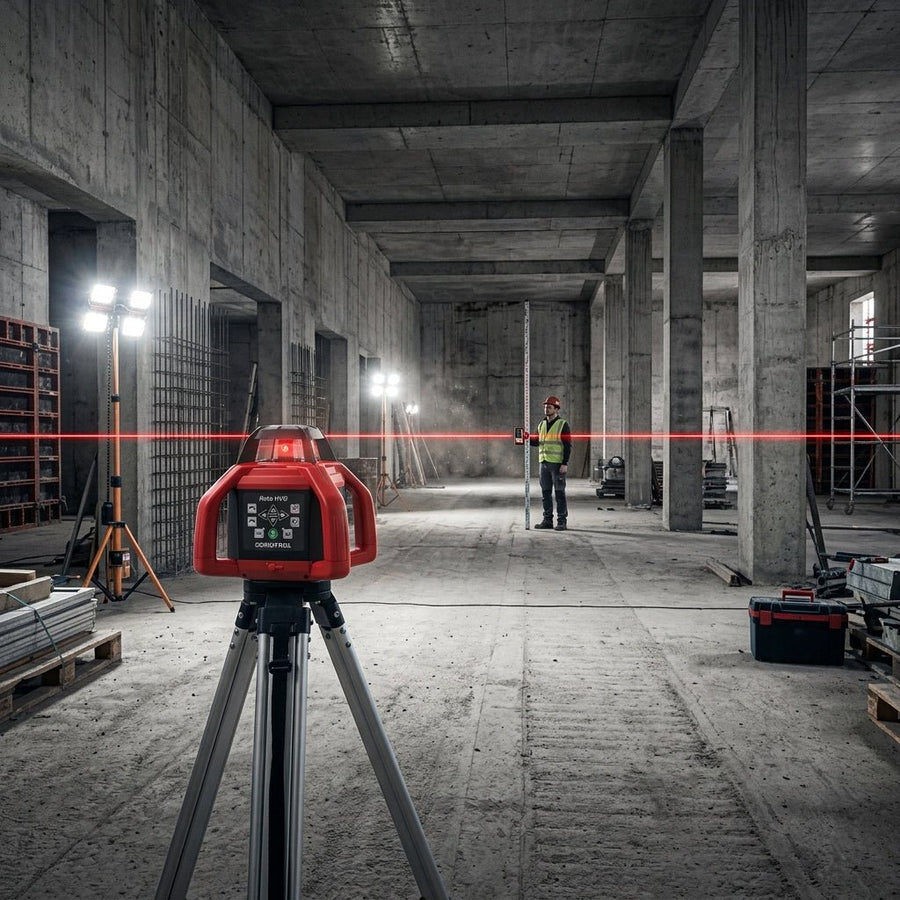
For height checks over larger outdoor areas, a rotary laser with a matching receiver may be the more sensible way of working. The decision depends on the task, not on the laser colour alone.
Comparing battery life properly
“Red” or “green” tells you nothing about the real runtime of any given model. Compare the specifications of the specific tool and note how many planes are switched on. Battery capacity, electronics and ambient conditions all affect operation.
Checklist before buying
- Which line or plane do you actually need?
- Can it be read at your workplace and on your surface?
- Are the mount and working height suitable?
- Is a compatible receiver confirmed for outdoor use?
- Are runtime and power supply sufficient for your work?
Compare the current cross-line lasers on the basis of these points. Colour is a selection criterion, not a promise of range or precision.