Pythagoras with a laser: measuring height correctly
In this article
You want to determine the height of a wall but cannot reach the top point? With the Pythagoras function of a laser distance meter you can calculate a vertical distance from several measured distances. For this, the target points must be reachable by the beam and the measurements must form a right-angled triangle. A tripod alone does not guarantee a correct result.
The short answer: when does Pythagoras work?
The method is suitable if you can reliably target the top point, a suitable horizontal reference measurement is possible and the measuring origin stays the same during all measurements. For an accessible distance, direct measurement is usually easier. If the tool is on a tripod, the simple two-point mode first measures the height above the tool's horizontal, not automatically the entire wall height from the floor.
What is actually calculated?
In a right-angled triangle: height = √(diagonal distance² − horizontal distance²). The diagonal distance leads to the top target point. The horizontal distance leads to the same vertical wall, at the height of the measuring origin. Both distances start at the same reference point.
Worked example: The diagonal distance is 5.00 m, the horizontal distance 4.00 m. This gives √(25 − 16) = 3.00 m. If the measuring origin is 1.20 m above the desired lower reference point, the total height in this geometry is 4.20 m. Adding is only correct if the 1.20 m was really measured vertically between this lower reference and the measuring origin.
Two or three measurements: what is the difference?
| Task | Suitable approach | Requirement |
|---|---|---|
| Height above the tool's horizontal | Two-point Pythagoras | Top point and horizontal reference measurement |
| Vertical section between two points | Three-point Pythagoras, if the tool supports this mode | Two target points on the same vertical plus the required reference measurement |
| Directly accessible distance | Direct distance measurement | Suitable support and target surface |
| Indirect height with tilt sensor | Model-specific height function | Supported function and correct alignment according to the manual |
The order of measurements and the symbols on the display differ depending on the model. Follow the display and the operating manual. A three-point mode is not a method using just any two diagonal distances.
Step by step: measuring a wall height
- Define the section. Do you want to measure from floor to ceiling or just from the tool height to an upper edge? Mark both reference points.
- Check the mode. Make sure your tool supports the Pythagoras mode you need. Camera viewfinder, timer and tilt sensor are additional functions, each with a different job.
- Set up the tool securely. Choose a position with a clear view of all target points. Keep the measuring origin as constant as possible when swivelling; moving around an arbitrary tripod point can shift it.
- Check the measuring reference. Front edge, rear edge or tripod thread: the selected reference must match the actual set-up and remain the same throughout the series of measurements.
- Measure the target points. Following the order on the display, aim at the top edge and the intended reference points. The horizontal distance must be at right angles to the vertical.
- Check the result. Repeat the complete series of measurements. Larger differences suggest checking the set-up, reference point and target surface first.
These errors change the calculated height
| Mistake | Consequence | Remedy |
|---|---|---|
| Horizontal reference measurement runs at an angle | The triangle is not right-angled | Determine the horizontal and common vertical reliably |
| Tool is moved between measurements | The distances have different origins | Stabilise the set-up and restart the whole series of measurements |
| Measuring reference does not match the support | The entered distances have a systematic offset | Check the reference setting before the first measurement |
| Laser hits glass, an edge or moving leaves | The tool does not reliably capture the desired point | Choose a fixed, suitable target; if target capture is unclear, use a different measuring method |
How accurate is indirect measurement?
The accuracy specification for direct distance measurement cannot be transferred unchanged to the calculated height. Several distances go into the calculation; alignment and measuring geometry also play a part. A small target height with large measured distances is particularly unfavourable: small distance errors can then carry considerable weight.
Repetition helps identify an unstable set-up. It does not eliminate a systematic error. For a binding measurement with tight tolerances, check the result using a suitable independent method.
Which features make the job easier?
A camera viewfinder helps you hit a distant target point. A timer delays triggering and can reduce movement caused by pressing the button. It does not automatically mean that several measurements are averaged. A continuous measuring mode is not the same as automatic height calculation either.
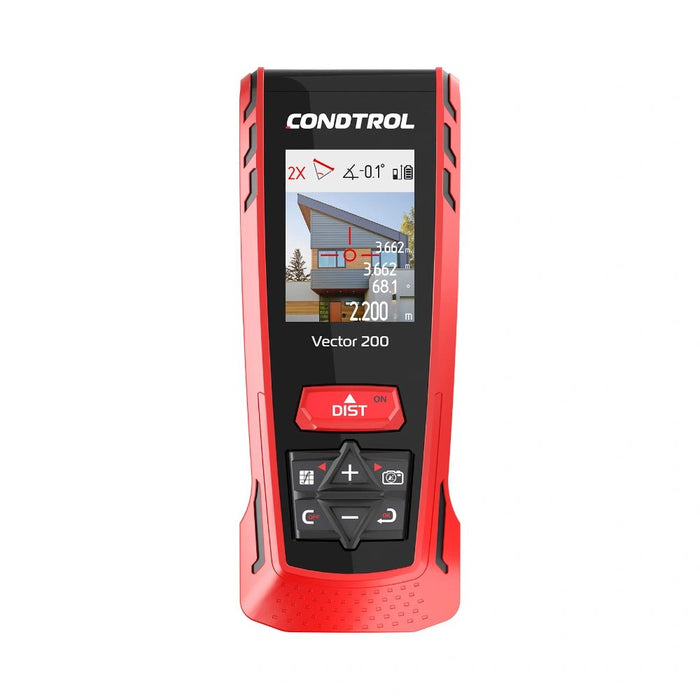
For longer distances, you can look at the CONDTROL Vector 200 and check its range of functions. Which equipment you actually need is explained in the guide to choosing a laser distance meter. For a single accessible indoor distance, a simpler model is often enough.
Frequently asked questions
Can I measure a height without hitting the top point?
With the Pythagoras method described, you must aim at the top target point. You do not have to touch it or reach it with a ladder. If it is concealed, you need a different measuring geometry or method.
Can I determine the whole wall height with two measurements?
Only if the measuring geometry covers the entire desired section. A measurement from a tripod often first gives the section above the tool's horizontal. The lower section must then be captured correctly.
Is a tripod mandatory?
It makes stable set-up easier. What remains decisive is the common measuring origin, the right-angled reference measurement and a reliably hit target.
Does the function help with moving treetops?
Moving and poorly reflective targets make capture more difficult. A series measurement does not automatically turn this into a reliable tree height measurement.
For your next measurement: first check the target point, measuring origin and reference height. Then choose the right mode. You will find more tools in the category Laser distance meters.