CONDTROL TruSlope: self-levelling & pendulum lock: perfectly straight lines – and exact slopes
Straight lines in a split second, reliable slopes for gradients or shower areas and stress-free transport: here you'll find out how to use self-levelling and the pendulum lock correctly – and why CONDTROL TruSlope works measurably more precisely on slopes.
In this article
- TL;DR: quick decision
- How self-levelling works
- Pendulum lock: what for & how
- Why TruSlope is more exact (sensor on the pendulum)
- Patent: vertical heads for 90° wall clearance
- How-to: straight & inclined lines (step by step)
- Set recommendations (application → tool → accessories)
- Avoiding typical mistakes
- How we test (methodology & safety)
- FAQ
Category: cross-line lasers · TruSlope · Omniliner G3D · Smart 4D Plus · Fliesen 4D · ULR receiver · Tripods & brackets · 2+1 years' warranty
TL;DR: quick decision
| Scenario | Recommendation | Why | Direct link |
|---|---|---|---|
| Straight lines in seconds | Self-levelling on | Pendulum adjusts automatically → horizontal/vertical lines are “straight” | Omniliner G3D |
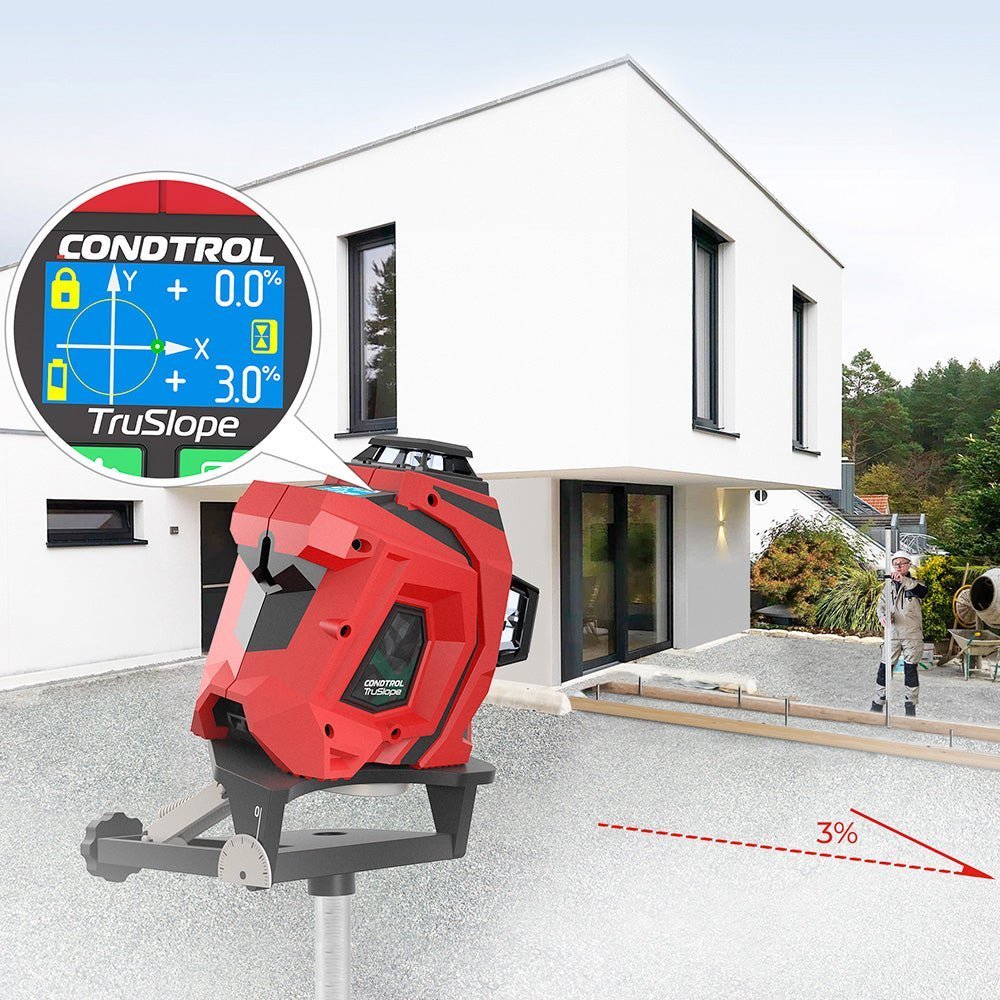
| Tilt/gradient (shower, ramp) | TruSlope (pendulum sensor) | Sensor sits on the pendulum → shows the actual pendulum angle, not just the housing position | TruSlope |
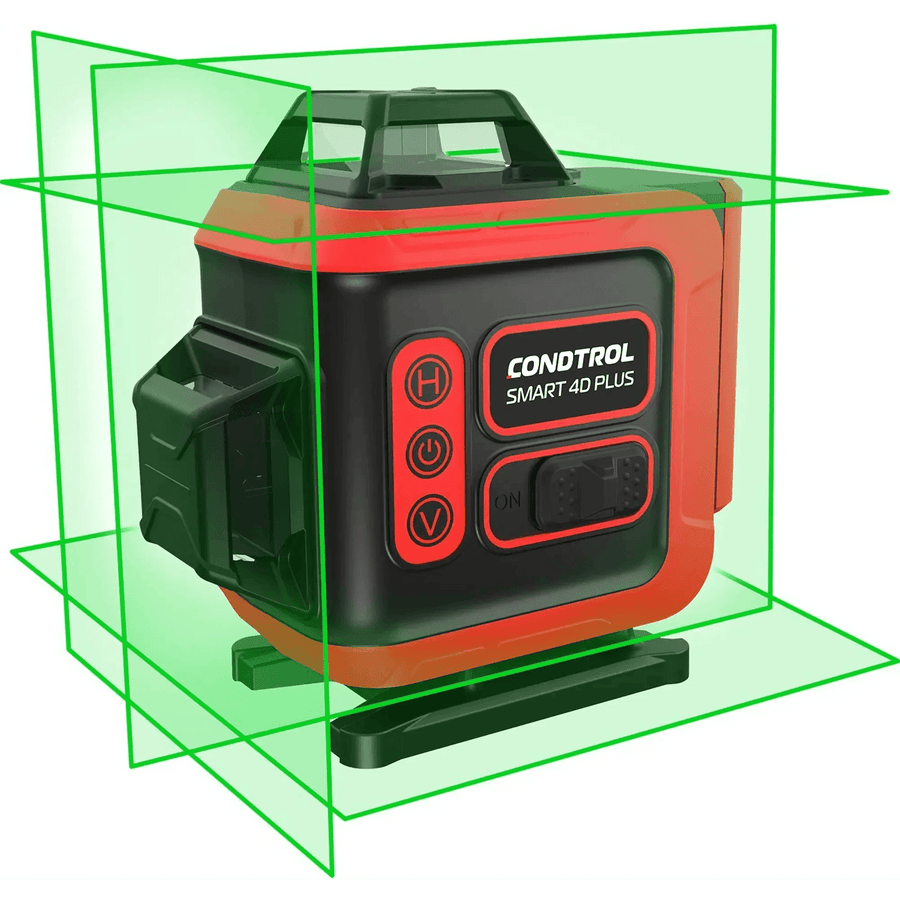
| Diagonal marking/transport | Pendulum lock (lock) | Fix the pendulum → set inclined lines freely; protection during transport | Smart 4D Plus |
| Flush to the wall at 90° | CONDTROL patent (vertical heads) | Vertical heads arranged so that you can get close to the wall and still operate the tool comfortably | View models |
How self-levelling works
Inside the laser there is a freely suspended pendulum block with the laser modules. As soon as you set the tool up within the self-levelling range (e.g. ±4°), the pendulum aligns itself under gravity – so the projected lines are horizontal/vertical. Outside the range, the tool warns you (flashing/beep).
Pendulum lock: what for & how
- Setting inclined lines deliberately: switch on the lock → the pendulum is fixed; you can deliberately project an inclined line.
- Protection during transport: a fixed pendulum is more shock-resistant, and the calibration stays more stable.
- Note: With the lock active, lines are not automatically straight – that is intentional (tilt mode).
Why TruSlope is more exact (sensor on the pendulum)
In many tools the tilt sensor is located in the housing. This can lead to deviations: the housing appears to be level, but the actual swinging pendulum block is slightly offset – the projected line would then not be at the desired angle.
CONDTROL TruSlope measures the angle where it arises: directly on the pendulum. As a result, the display shows the angle actually set on the pendulum – not just the position of the housing. Result: more precise tilt display and reproducible gradients, e.g. for showers, terraces or ramps.
More details: TruSlope product page »
Patent: vertical heads for 90° wall clearance
For working flush to the wall at 90° CONDTROL has developed a patented arrangement of the vertical laser heads: the heads are positioned so that the lines reach right up to the wall while you still have full access to the tool & controls. This saves space and time and avoids contortions – especially in interior finishing, tiling and electrical work.
How-to: straight & inclined lines (step by step)
1) Perfectly straight (self-levelling)
- Place the tool on a tripod/bracket and align it within the levelling range.
- Leave self-levelling active → lines become straight automatically.
- For long distances use the ULR receiver (pulsed mode).
2) Exact slope with TruSlope
- Activate the pendulum lock (tilt mode).
- Set the desired angle on the tool; TruSlope shows the real pendulum angle.
- Guide/mark the line; repeat on both planes if necessary (e.g. shower gradient).
3) Transport & storage
- Activate the pendulum lock and transport the tool in its case.
- Regularly do a visual check/test shot on a known reference (e.g. a building line).
Set recommendations (application → tool → accessories)
| Application | tool | Accessories | Advantage |
|---|---|---|---|
| Drywall/interior finishing | Omniliner G3D | Telescopic pole, wall bracket | 3×360° lines, full room coverage |
| Tiles/bathroom (two planes) | Fliesen 4D / Smart 4D Plus | Tripod, target plate | 2×H + 2×V at the same time, perfect grid |
| Slopes (gradients) | TruSlope | Tripod | Pendulum sensor measures the real angle → more exact results |
| Outdoors / long distances | Your favourite + receiver | ULR receiver | Reliable indication of the line centre in sunlight |
Avoiding typical mistakes
- Forgot the lock: in tilt mode with the lock active, lines are not automatically straight – that is intended!
- On unstable ground: vibrations → always use a tripod/bracket.
- Looking only at the housing: for slopes, what counts is the pendulum angle – TruSlope displays it correctly.
- No receiver outdoors: sunlight eats up contrast – use the ULR receiver.
How we test (methodology & safety)
- Levelling check: reference line at 5/10/15 m, 3 repetitions, document the spread.
- Tilt check: comparison against known angles (gauge), display vs. marking.
- Safety: Tools of laser class 2 (DIN EN 60825-1) – never look into the beam deliberately.
FAQ
What is the pendulum lock for?
For setting inclined lines (tilt mode) and to protect the pendulum during transport.
Why is TruSlope more accurate on slopes?
Because the sensor sits on the pendulum and measures the real pendulum angle. A housing sensor can deviate if the pendulum is slightly offset.
What does the patented arrangement of the vertical heads bring?
You can get the laser flush to the wall at 90° and still operate the tool comfortably. This saves time and makes markings more precise.
How often should it be checked/calibrated?
At least once a year or after an impact/transport. Details & conditions: 2+1 years' warranty.