Pyrometer comparison: Maxwell 2, 3 or 4 – which model for which task?
In this article
An infrared pyrometer measures surface temperatures without contact – practical for heating and electrical systems, thermal bridges or overheated components. CONDTROL offers three Maxwell models with different measuring ranges and features. Which is enough depends on the temperature window and whether you also need to measure humidity.
How does an infrared pyrometer work?
Every object above absolute zero emits infrared energy – the higher the temperature, the more. The pyrometer focuses this radiation through a lens onto a sensor and converts it into a temperature reading, in fractions of a second and without contact with the object. A laser target circle only marks the target direction – it is not the laser dot itself that is measured but the entire area within the so-called measuring spot.
What matters is the optical ratio (distance to spot size): for all three Maxwell models it is 12:1. From 120 cm away, the tool therefore captures an area of around 10 cm in diameter – important to know if you want to check small components from a distance: too far away and you are no longer measuring the component but the surroundings as well.
When do you need a pyrometer?
- Looking for thermal bridges on external walls, window reveals or roller shutter boxes before the heating season
- Checking heating pipes, underfloor heating or radiators for even heating
- Checking electrical control cabinets and fuses for unusual heating – an early warning sign of loose contacts
- Diagnosing overheating of bearings, motors or brakes in vehicles and machines
- Estimating mould risk in combination with humidity (Maxwell 4 only)
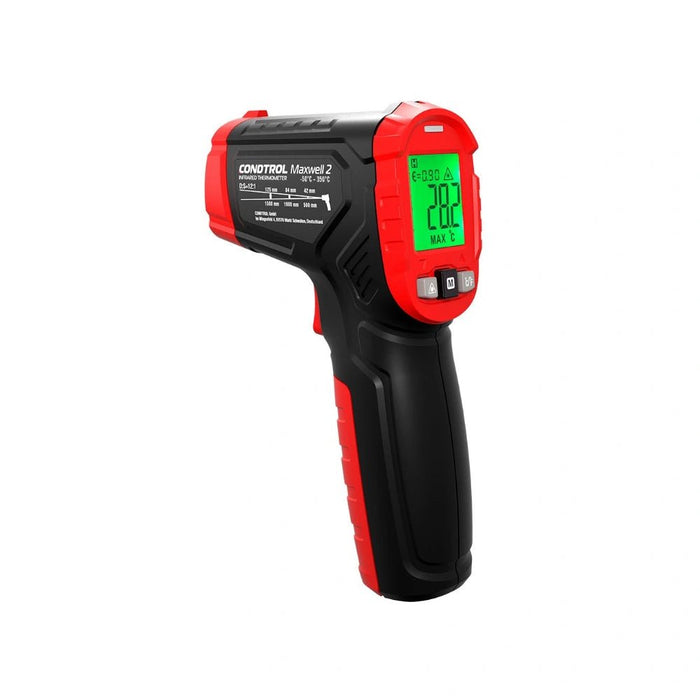
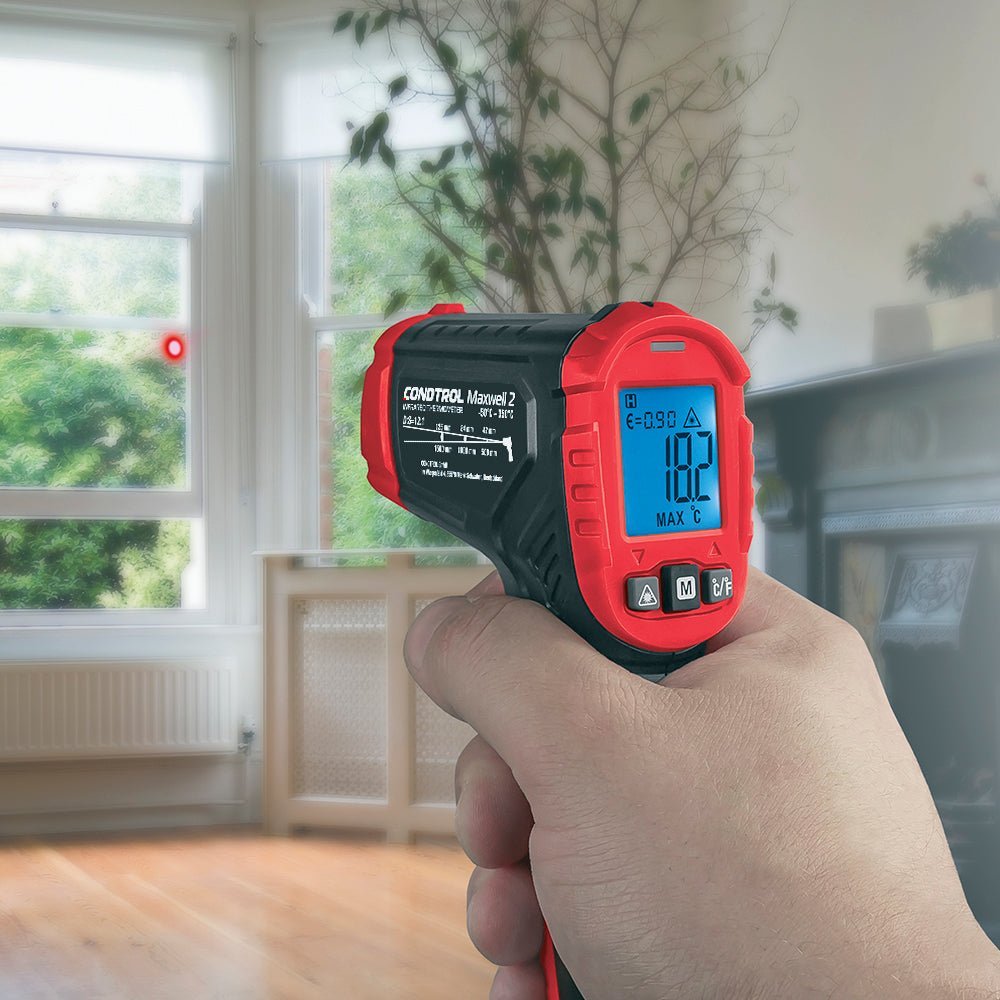
Maxwell 2 – the affordable all-rounder
The Maxwell 2 covers –50 °C to +350 °C – the widest range at the cold end of the three models, so also ideal for measurements on very cold surfaces such as freezer systems or refrigerant lines. Coloured display backlighting (blue/green/red) instantly shows whether a value is outside the set limits – in addition to the acoustic signal, which is particularly useful in noisy environments. Adjustable emissivity, data hold function to freeze the reading when the display cannot be seen directly while measuring.
For whom: DIYers and tradespeople looking for an affordable all-round tool for building services and vehicles.
Maxwell 3 – compact and light
The Maxwell 3 measures –30 °C to +380 °C and weighs only 130 g – the lightest tool in the series, easy to carry on your belt and does not get in the way of other work. The laser circle sight can be switched off at short distances to save battery – useful if you know where you are aiming anyway. Warning signal when limits are exceeded, adjustable emissivity for different material surfaces.
For whom: frequent, longer measurement series where weight and comfort count – for example on daily rounds of a facility.
Maxwell 4 – with integrated hygrometer
The Maxwell 4 measures –30 °C to +800 °C – the widest range at the top end of the series – and is the only model with a built-in hygrometer for humidity. That is the decisive difference: temperature alone does not tell you whether there is a risk of mould at a spot – only in combination with relative humidity can you estimate whether the dew point is reached on a cool surface. The Maxwell 4 shows exactly that directly, without a second tool. The pistol shape sits more comfortably in the hand for longer one-handed use than a stick design.
For whom: renovation, mould prevention, air conditioning/ventilation – wherever temperature alone is not enough.
Comparison at a glance
| Maxwell 2 | Maxwell 3 | Maxwell 4 | |
|---|---|---|---|
| Price | 45 € | 55 € | 79,90 € |
| Measuring range | –50 °C to +350 °C | –30 °C to +380 °C | –30 °C to +800 °C |
| Optical ratio | 12:1 | 12:1 | 12:1 |
| Humidity measurement | No | No | Yes (hygrometer) |
| Weight | Default | 130 g | Standard, pistol shape |
| Limit alarm | Yes, colour-coded | Yes | Yes |
| Data hold | Yes | Not specified | Not specified |
Common measuring mistakes
- Measuring through glass or shiny surfaces: infrared pyrometers only measure the surface directly in front of the lens – glass, polished metal or reflective films distort the result considerably.
- Measuring spot too large for the object: at 12:1, a wide area is captured from a long distance – move closer for small components, otherwise the ambient temperature mixes into the result.
- Emissivity not adjusted: the factory emissivity does not suit every surface – on bare metal or very light surfaces, the reading can deviate noticeably.
- Measuring immediately after changing location: after moving from cold to warm (or vice versa), the tool itself needs a moment to adjust before the values are stable.
Conclusion
If an affordable all-rounder is enough – Maxwell 2. If weight and frequent carrying matter – Maxwell 3. If it's about mould risk, thermal bridges or very high temperatures up to 800 °C – only the Maxwell 4 also measures humidity.
FAQ
Which model detects mould risk most reliably?
The Maxwell 4 – thanks to the integrated hygrometer you see temperature and humidity together, which is decisive for assessing thermal bridges.
Can I measure through glass or shiny surfaces with a pyrometer?
No, infrared pyrometers only measure the surface temperature of the first object in front of the lens – smooth, reflective surfaces distort the result.
What does the optical ratio 12:1 mean?
From 120 cm away, the tool captures a measuring spot of about 10 cm in diameter – the further away, the larger the measured area.
Why do two pyrometers show different values at the same spot?
Usually it is due to the set emissivity or the distance to the object – both factors directly affect the result.
Is the Maxwell 2 enough for radiators and underfloor heating?
Yes, its range up to +350 °C easily covers usual heating temperatures.
Do you need a special model for outdoor use in winter?
The Maxwell 2 measures down to –50 °C and is therefore best suited for winter and refrigeration applications.