Digital concrete test hammer or mechanical rebound hammer: what you really need
In this article
The rebound hammer has been the standard tool for testing concrete strength without drilling cores for decades. The principle comes from Ernst Schmidt and is simple: a tensioned spring strikes the surface, the rebound is measured and converted into compressive strength. The only question is whether you read and convert the result yourself or whether the tool does it for you.
How the measurement works
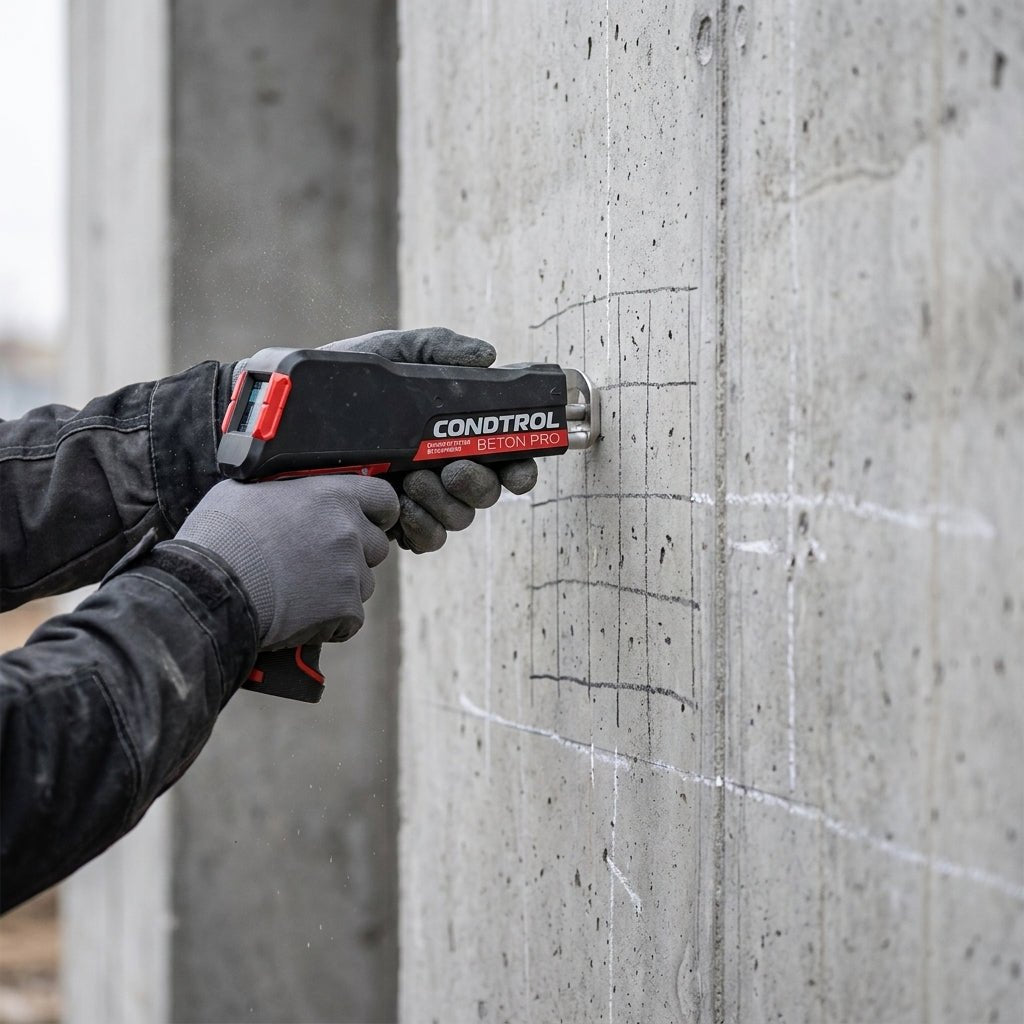
The hammer is placed perpendicular to the test surface and pressed evenly until the plunger releases. The rebound value depends on the hardness of the surface. According to DIN EN 12504-2, you do not test at one point but take several impacts on an area and calculate the average.
Three things reliably distort the result: a rough or damp surface, a hammer applied at an angle and measurements too close to edges or reinforcement. Grind the surface smooth beforehand, keep at least a few centimetres from the edge, note the impact direction.
Mechanical or digital: the real difference
With the mechanical tool, you read the rebound value on the scale and convert it into megapascals using a curve. It works, but requires care and a paper record.
A digital tool does three steps itself: it records the impact direction, converts to the selected unit and saves the average. With dozens of measuring points a day, that's not convenience but error prevention.
| CONDTROL Beton | CONDTROL Beton Pro | |
|---|---|---|
| Principle | mechanical, scale | digital with display |
| Measuring range | 10 to 60 MPa | 3.5 to 99.9 MPa |
| Deviation | up to 20% | ±7 % |
| Units | MPa via curve | MPa, N/mm², kg/cm², PSI |
| Memory | – | up to 500 averages |
| Impact direction | take into account manually | is recorded |
| Standard | DIN EN 12504-2 | ISO 8045, EN 12504-2, DIN 1048 |
| Weight | 1.1 kg | 600 g |
| Price | 439,90 € | 1.489,90 € |
Who needs which tool
Mechanical is enoughif you occasionally check screeds or concrete floors for uniformity and only need the values internally. Site managers, renovators, precast plants with simple checks.
Digital is worthwhileas soon as you have to document and pass on results: expert reports, acceptance, series quality control. The Beton Pro stores 500 averages, runs for 25 hours on two AA cells and calculates in the unit your client wants to see. The wider measuring range from 3.5 MPa also helps, for example with young concrete and lightweight concrete.
If you are only choosing between our two models, the direct comparison helps: Concrete test hammer: Beton or Beton Pro.
Measuring cleanly in five steps
Choose an area that is dry, level and free of plaster. Smooth it with the grinding stone. Place at least nine to ten impacts in a grid, about 25 mm apart. Discard outliers at the top and bottom. Calculate the average and record the impact direction and concrete age in the report.
A note that often gets lost: the rebound hammer measures the surface, not the core. If there are doubts about the load-bearing capacity, it does not replace drill core testing, but it quickly shows you where to look more closely. Moisture also plays a role, so it is worth taking a parallel look at moisture measurement in construction.
FAQ
How accurate is a rebound hammer?
Mechanical tools typically have a deviation of up to 20%, digital ones considerably less. The Beton Pro works with ±7%. Preparing the surface remains decisive.
Which standard applies in Germany?
DIN EN 12504-2 governs rebound testing of concrete in structures. The Beton Pro also complies with ISO 8045 and DIN 1048.
Can I also test brick or mortar with it?
Yes, with appropriate calibration curves. Both tools are designed for this, but the values should only be read comparatively.
Does the hammer need to be calibrated?
Regular checks on the test anvil are a must, otherwise the values drift. We carry out calibration and service in-house in Germany.
You will find both tools in the category A concrete test hammer. Free shipping within Germany, 2+1 years' warranty after registration.