Construction lasers: which tool for which task on site?
A construction laser can project lines for alignment, create a reference plane for height checks or measure distances. These tasks are different. First choose the result you want, then the tool, range and accessories.

In this article
Which construction laser for which task?
| Task | tool | Check before buying |
|---|---|---|
| Aligning shelves, the first row of tiles or kitchen units | Cross-line lasers | Line course, fixing and visibility |
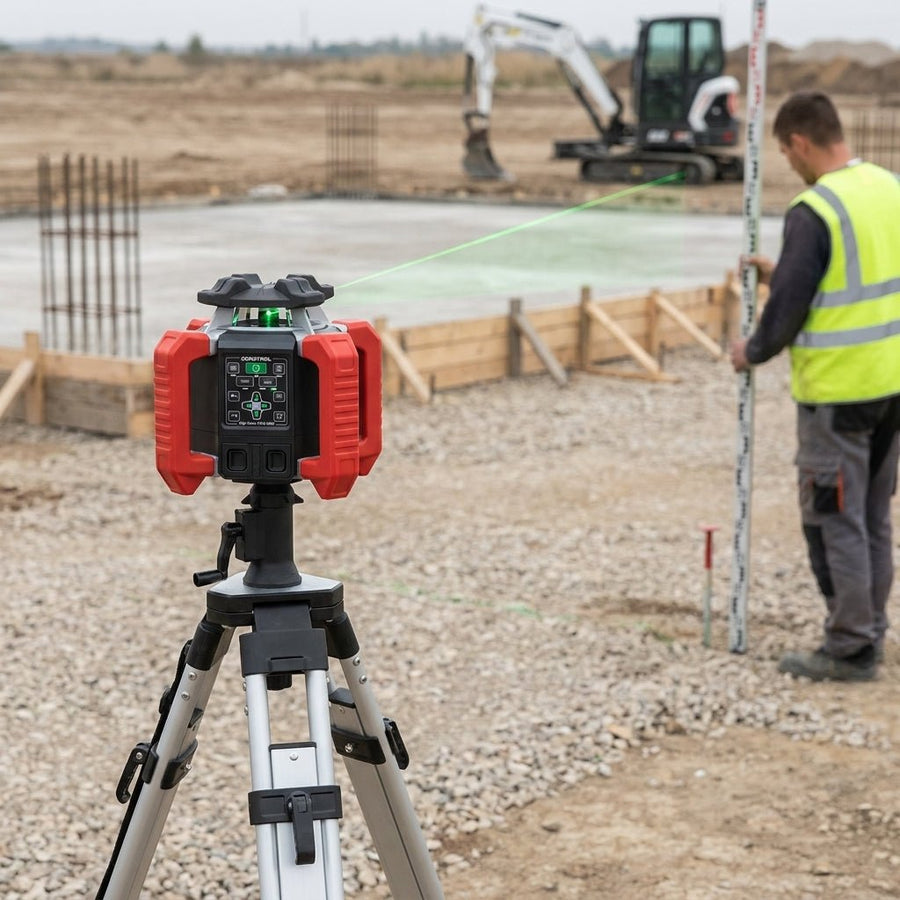
| Transferring reference heights on outdoor areas | rotary laser with a matching receiver | Receiver operation, radius or diameter, tripod |
| Recording room lengths and measurements | Laser distance meters | Measuring reference, target surface and calculation functions needed |
Cross-line lasers: how many planes do you need?
For a single wall, one horizontal and one vertical line are often enough. The green Smart 2D Plus produces a line cross; it is not an all-round 360° plane. When working on several walls or on the floor and ceiling, a tool with several 360° planes can make sense. The Smart 4D Plus has two horizontal and two vertical planes.
Kitchen example: for a height line on one wall, a line cross is often sufficient. If the same height is to be visible all around the room without repositioning, compare the actual plane configuration. “2D”, “3D” and “4D” are not a uniform standard across all manufacturers.
Rotary lasers: checking heights outdoors with a receiver
A rotating beam defines a reference plane. In daylight it is typically detected with a compatible receiver. A range of several hundred metres does not mean that the eye sees a continuous line there. Also check whether the figure in metres describes a radius or the diameter of the working area.
For gradients you need a suitable tilt function and an independent check of the heights. A tilted tool is not automatically a digital tilt laser. Compare the current rotary lasers and their scope of delivery.
Distance meters: measuring instead of aligning
A distance meter captures the distance to the target. Area, volume and indirect height functions differ by model. It does not create a reference line for aligning components and does not replace the tape measure for every task, for example on concealed or unsuitable target surfaces.
A practical selection process
- Define the result: line, reference height or length?
- Check the working environment: indoors or daylight outdoors?
- Compare target distance and desired accuracy with the conditions in the manual.
- Check receiver, bracket, tripod and power supply; only choose accessories with explicitly confirmed compatibility.
- Check the scope of delivery before ordering additional parts.
What does “level” mean?
The term covers various instruments. An optical level determines height differences by reading a staff and does not project a laser line. Line and rotary lasers, on the other hand, use a laser reference. The task determines the right technology.
Frequently asked questions
Can a cross-line laser work outdoors? Depending on the model and conditions, possibly with a compatible receiver and the intended mode. There is no general limit of 20 or 25 m for all tools.
Is green more accurate? Colour does not automatically improve accuracy. It mainly affects perception; accuracy, levelling and measuring method must be checked separately.
Does self-levelling compensate for any tilt? No. It only works within the range of the respective model. Outside this range, the warning in the manual applies; a locked pendulum does not create an automatically level plane.